

By Arnold Bakabweyaka
Arnold is Project Officer, Infectious disease – AMS/IPC at Uganda UK Health Alliance. Following a knowledge-exchange visit to the Cambridge University Hospitals, Arnold reflects on key insights and practical lessons for strengthening AMS and IPC in resource-limited settings.

The Kampala Cambridge Health Partnership with funding from the Commonwealth Partnerships for Antimicrobial Stewardship (CwPAMS) 2.5 programme, supported by UK Department of Health and Social Care’s Fleming Fund, and managed by the Commonwealth Pharmacists Association (CPA) and Global Health Partnerships (Formerly THET), implemented projects focused on AMS and IPC from 2019-2025. Makerere University Department of OBGYN, Mulago Hospitals, Cambridge University Hospitals NHS Foundation Trust and CGHP have been working together within this partnership.
The last phase aimed to build on previous gains by strengthening diagnostic AMS and IPC across two hubs and two spoke sites in Kampala, Uganda. The hubs are tertiary facilities providing specialised maternal and neonatal health services while the spokes are primary health care facilities providing general out-patient services.
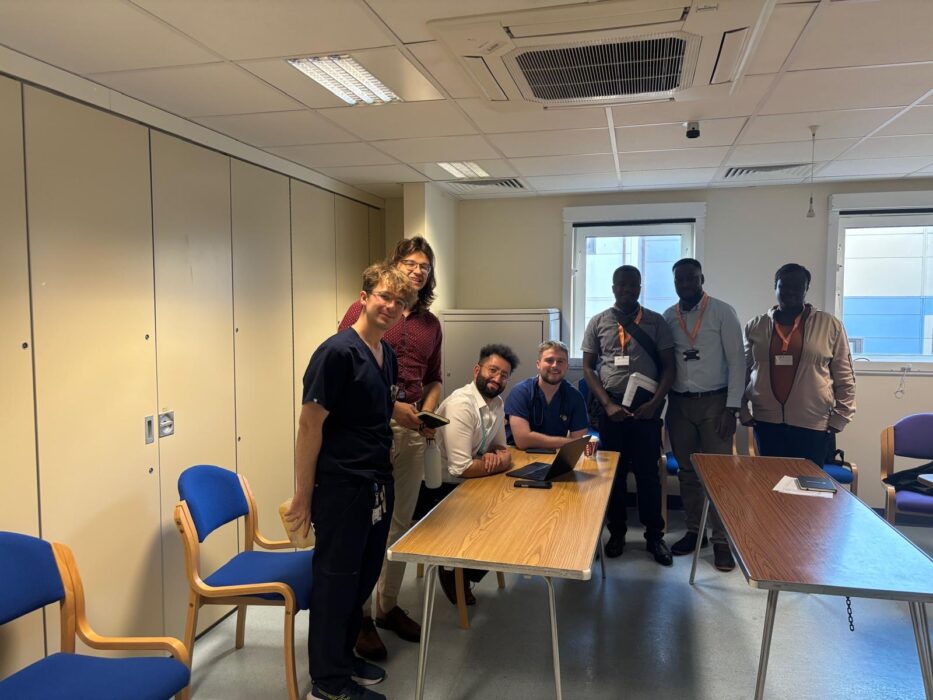
In line with CGHP’s partnership model of reciprocal learning, key staff members from Kampala visited Cambridge University Hospitals (CUH) to gain further knowledge and understanding about AMS and IPC through observations, meetings and discussions with technical experts at CUH. The team visited Addenbrooke’s Hospital, The Rosie Hospital and Royal Papworth Hospital.
This experience offered a first-hand look at mature, well-resourced AMS and IPC programmes and the advanced strategies employed to optimise antibiotic use, combat resistance and prevent spread of hospital acquired infections.
This blog summarises my key observations, the innovative practices I encountered, and the lessons I plan to carry forward in my practice.
Key observations and program pillars
The AMS and IPC programs at CUH are well-integrated, multidisciplinary initiatives supported by strong institutional and governmental commitment:
- Multidisciplinary teams: The core AMS team comprises infectious disease specialists, clinical pharmacists, microbiologists, infection prevention and control (IPC) professionals, and nurses. The IPC team comprises certified infection control nurses, infectious disease doctors and microbiologists, deputy director and chief nurse. This collaborative approach ensures comprehensive oversight and effective implementation of stewardship strategies.
- Robust diagnostic and surveillance systems: The institution benefits from a highly advanced, automated and efficient laboratory system providing microbiology, serology and molecular techniques such as real-time PCR, next-generation sequencing (NGS), and MALDI-TOF mass spectrometry. There is an expedited relay of microbiology results; negative growth in 24 hours for adults, within 36 hours for paediatrics, and positive growth at 48 hours with species identification and susceptibility profiles relayed on the same day. The LIAISON XL analyser and Panther Fusion SARS-CoV-2/Flu A/B/RSV assay enable comprehensive patient evaluation and enable rational antimicrobial use. The surveillance data generated allows for targeted interventions and the optimisation of local guidelines, a stark contrast to many resource-limited settings where such data is scarce.
- Integrated technology: The efficiency of EPIC, their electronic medical records (EMR) system is a game-changer. It provides monthly auto-generated antimicrobial use and consumption department and facility reports, provides automatic alerts for prolonged antibiotic use, duplicate coverage, and guides appropriate prescribing based on local antibiograms, facilitating adherence to guidelines. It can also be used to trace a patient’s movement and contacts during their hospital stay in case of highly contagious pathogens or during disease outbreaks.


Core AMS interventions in practice
I observed several core interventions in action that are highly effective in this setting, some of which are highlighted below:
- Prospective audit and feedback: A significant portion of my time was spent on AMS team ward rounds, conducting prospective audits and providing direct, non-confrontational feedback to prescribing specialists. This educational approach was well-received and highly effective in optimising treatment regimens, including dose adjustments, de-escalation, and appropriate duration of therapy.
- Laboratory-clinician feedback: The EPIC system allows for timely alerts when microbiology results are ready, both preliminary and final. Its integrated “in-basket” messaging system improves communication and care transitions between the microbiology team and physicians directly involved in patient care.
- Guideline implementation: Addenbrooke’s, The Rosie and Royal Papworth Hospitals have their own facility-specific antimicrobial guidelines based on the data generated from the laboratory and general NHS guidelines. These are routinely discussed and optimised by the AMS team. During the visit, we sat in on discussions for indications for use of IV amoxiclav for HAI-pneumonia and pyelonephritic empiric therapy during pregnancy. A highlight was the discussion of the neonatal guidelines at The Rosie with the intermittent aminoglycoside dosing in neonatal sepsis and therapeutic drug monitoring that we are not doing back home.
- Pharmacists’ empowerment and leadership: The departments have individual pharmacists attached who audit antimicrobial use and encourage early IV-PO switch on the ward. Independent prescribing training and advanced clinical practice training has further empowered pharmacists within the NHS to audit doctor’s prescriptions.
Core IPC interventions in practice
- Hand hygiene: The staff observed were highly compliant to the moments of hand hygiene on the ward and performed hand rub before entering the wards without reminders. CUH has also introduced a mandatory ‘Bare Below the Elbows’ requirement for health workers on wards, as anything that impedes effective hand hygiene increases the risk of transmitting infections to patients and staff.
- Early detection and prevention of exposure:
- Meticillin‑Resistant Staphylococcus aureus (MRSA) patient and staff screening and decolonisation.
- Microbiology watch list coordination and EPIC alerts on patient specific IPC precautions with follow up at point of care and isolation where required.
- Clostridium difficle rounds by microbiologists.
- Surveillance: The IPC team supports CUH surveillance in line with NHS focus areas; i.e. MRSA, C. difficile, ESBL-producing organisms, MSSA bacteraemia, E.coli bacteraemia and Glycopeptide Resistant Enterococci (GRE) bacteraemia, Streptococcus pyogenes, Norovirus, Respiratory Syncytial Virus (RSV), SARS-Cov
- Education and training: Mandatory staff induction and training is done annually.

Reflections and future direction
The observership highlighted the vital role of infrastructure, motivated human resources, and data availability in running a successful AMS programme. While the high-income setting has distinct advantages such as dedicated funding and advanced technology, many of the underlying principles are universally applicable:
- Leadership and accountability: The importance of strong leadership and clear accountability cannot be overstated.
- ‘Low-hanging fruit’ interventions: Low-cost interventions implemented consistently can lead to change in antimicrobial prescribing practices. These include AMS ward rounds with technical individuals who have respect amongst prescribers and the ‘Bare Below the Elbows’ requirement to improve hand hygiene compliance.
- Contextualisation is key: Strategies successful in a high-consumption HIC may not exactly be suitable for low- and middle-income countries (LMICs) like Uganda where we still struggle with access issues. Tailored, setting-specific approaches are crucial.
- The power of collaboration: The seamless collaboration between the clinical and microbiology departments serves as a powerful model for improving patient care and outcomes.
- Culture is a mindset and is not permanent: With the right message and motivation, healthcare workers can improve their adherence to IPC precautions like hand hygiene practice and reduce irrational antimicrobial prescriptions.
- Leveraging technology and bioinformatics. The Uganda Health Information Management System (EAFYA) needs to be optimised to harness its potential to improve AMS and IPC through clinical decision support tools and making it efficient to support surveillance. An efficient and reliable country-wide EMR would enable enhanced surveillance and outbreak prediction using AI modelling.
Professional growth: This experience has reinforced my commitment to advancing AMS and IPC efforts back home by adapting lessons on multidisciplinary teamwork, data utilisation, and consistent education even with resource constraints. This exposure further steers my passion in the infectious disease field with global reach/impact.
In conclusion, from what I observed, strong leadership and accountability were key drivers of success of the AMS and IPC programmes at CUH. This eye-opening experience provided tangible examples of effective strategies and the systemic support required to rationalise antimicrobial use whilst preventing hospital infection transmission in my setting. I am grateful for the experience and look forward to translating these insights into actionable change.
—
Return to blogs